
An email was sent. Training was delivered. The new capability went live on schedule.
But are people using it? Are they confident in the new process? Is the release delivering the outcome it was designed to achieve?
These questions reveal the difference between completing adoption activities and achieving adoption. Communications and training are important, but their completion does not automatically mean user behavior has changed.
To understand whether a ServiceNow release is delivering value, organizations need to measure what happens after launch and use that information to continuously improve the experience.
Define adoption before the release
Adoption should not be measured with one universal metric. The right indicators depend on the capability, the audience, and the outcome the organization is trying to achieve.
Before launch, teams should define what successful adoption will look like. That could mean more employees using self-service, fewer requests submitted through email, increased use of a new workspace, improved completion of required fields, or faster resolution of a specific process.
Establishing clear target behaviors creates a shared definition of success across technical, business, training, and communications teams. It also makes it possible to identify the data needed to establish a baseline and monitor progress.
Measure more than activity
Sending communications and delivering training confirm that adoption efforts occurred. They do not confirm that the release changed behavior or improved outcomes.
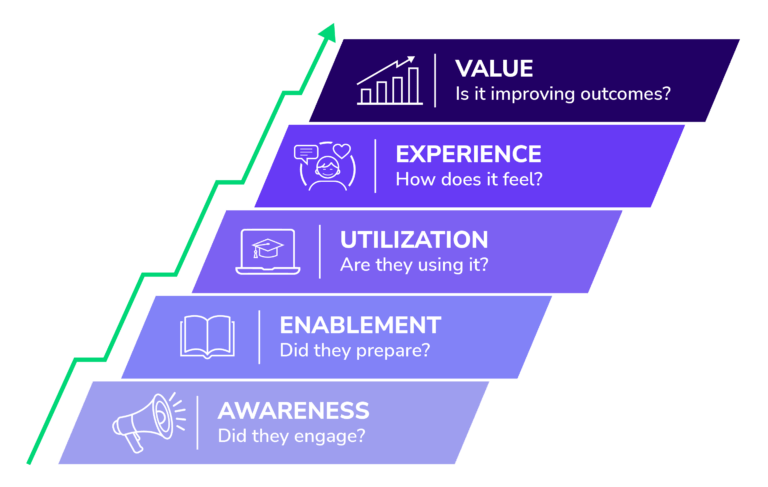
A balanced adoption scorecard can include five levels of measurement:
Awareness
Did the intended audience receive and engage with release communications?
Measures may include message reach, email engagement, event attendance, intranet visits, and video views.
Enablement
Did users access the resources designed to prepare them?
Measures may include training participation, completion rates, Guided Tour engagement, knowledge article views, and use of quick-reference materials.
Utilization
Are users applying the new capability in their work?
Measures may include feature usage, transaction volume, repeat use, completion of target behaviors, and movement away from legacy processes.
Experience
How do users feel about the change?
Measures may include satisfaction, confidence, qualitative feedback, support requests, and common points of confusion.
Value
Is the release improving the process or experience it was designed to address?
Measures may include time saved, reduced manual effort, improved service levels, better data quality, fewer errors, or other relevant business outcomes.
Looking across these levels helps teams understand not only whether adoption is low, but why.
Combine data with user feedback
Platform data can show what users are doing. Feedback can help explain what is driving that behavior.
For example, low utilization may appear to be a training problem. Interviews or support requests may reveal that users understand the new capability but find it difficult to incorporate into their existing process. In another case, strong training completion paired with low usage may indicate that employees do not understand when or why to use the feature.
Combining quantitative data with surveys, interviews, office hours, and support trends creates a more complete view of adoption. It helps the organization choose the right response instead of assuming every challenge requires more training.
Use the findings to refine the campaign
Adoption data is only valuable when it informs action.
If one stakeholder group is not engaging with communications, the message or channel may need to change. If users repeatedly struggle with one task, the organization may need a short demonstration, revised Guided Tour, or clearer job aid. If support questions reveal a platform issue, the solution itself may need to be adjusted.
The response could include:
- Targeted follow-up communications
- New role-based microlearning
- Updated knowledge articles and quick-reference materials
- Additional office hours or manager briefings
- Revised in-platform guidance
- Platform or process improvements
This turns adoption into a continuous cycle of measuring, learning, and improving.
Keep adoption content current
ServiceNow environments continue to evolve after a release. Workflows change, interfaces are updated, and new capabilities are introduced. Training and support materials need to evolve with them.
Without clear ownership and governance, outdated screenshots, instructions, and links can remain in circulation. This creates confusion and can reduce confidence in both the content and the platform.
Each resource should have an owner, review schedule, version history, and defined retirement process. Content reviews should also confirm that accessibility requirements continue to be met when materials are revised.
Treating adoption content as a managed asset helps ensure users receive accurate and useful guidance throughout the life of the platform.
Make every release an opportunity to improve
Adoption does not happen at one moment. It develops as users encounter a new capability, apply it to their work, provide feedback, and build confidence.
Organizations that measure this process can see where users are succeeding, where they need support, and where the platform experience can be improved. They can also apply those lessons to future releases, creating a stronger and more repeatable approach to adoption over time.
iTech AG helps organizations define adoption goals, evaluate utilization and user feedback, maintain enablement content, and translate findings into practical improvements. The result is a ServiceNow program focused not only on delivering capabilities, but on achieving measurable value.
Do you know whether your latest ServiceNow release is being adopted? Talk with iTech AG about creating an adoption measurement and continuous improvement strategy.