Most AIOps conversations start in the wrong place.
The first questions are usually about the model. How good is the correlation engine? What anomalies can it detect? How much alert noise can it eliminate?
Those are fair questions. They just are not the ones that determine success.
For those unfamiliar with the term, AIOps applies machine learning, analytics, and automation to operational data.
The goal is to help organizations identify issues earlier, understand impact faster, and resolve problems with less manual effort.
The attention is earned. Environments are becoming more distributed and interdependent. Telemetry continues to outpace what any team can realistically analyze by hand and alert fatigue remains a persistent challenge.
In practice, AIOps can correlate events, detect anomalies, identify likely root causes, predict service degradation, recommend actions, and trigger automated routine workflows. Those capabilities matter. But they only become operationally useful when the platform understands the services, assets, changes, vulnerabilities, owners, and users behind the signal.
Across many AIOps initiatives, a consistent pattern emerges. The organizations getting real value are not always the ones with the most advanced algorithms. They are the ones that invested in building operational context first.
The Context Problem
It helps to remember what these models do well. They find patterns, cluster related events, and flag the unusual.
What they cannot do on their own is tell you what any of it means to the business.
Take a single alert. A host crosses a CPU threshold. By itself, that is just a technical signal.
It says nothing about which service the host supports, who owns it, whether the workload is critical, or whether it carries an open vulnerability. The model can tell you the spike is abnormal. It cannot tell you whether it matters. And that is the question teams need answered at two in the morning.
That gap is the context problem.
Operational context is what turns a signal into a decision. It provides the relationships, ownership, history, risk, and service data to understand why something matters and what action to take. Without it, AIOps gives you noise that is faster and better organized, but still noise.
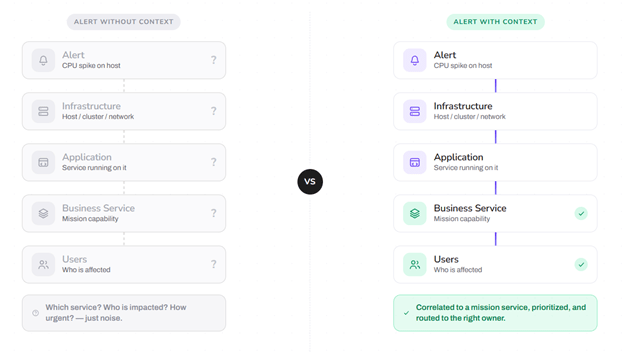
An alert without context is just a faster way to ask the same question: should we care?
And the context does not come from the AI. It comes from the disciplines the AI sits on top of: ITOM, ITSM, ITAM, and SecOps.
The Four Operational Domains
IT Operations Management
IT Operations Management is where the structural picture lives. Discovery, inventories what is running and how it connects. Service Mapping ties infrastructure and application components to the business services they support. Event Management helps teams reduce noise and identify relationships across operational signals.
The reality is many organizations have Discovery, fewer have it tuned, and very few have Service Maps they genuinely trust.
When the maps are accurate, an alert on an unremarkable host becomes “the claims portal is at risk.” When they are stale, the AI inherits the staleness and reasons confidently from the wrong picture.
IT Service Management
IT Service Management holds the institutional memory: incidents, problems, changes, requests, and knowledge. It is the record of how an environment behaves over time.
On almost every incident bridge, one of the first questions is, “what changed?”
A recent change record or the resolution from a similar issue often provides the fastest path to understanding impact and identifying next steps. Without that history, every incident gets treated as the first of its kind.
ITSM gives AIOps the operational memory needed to move beyond detection and into better triage, routing, remediation, and learning.
IT Asset Management
IT Asset Management adds ownership, lifecycle, and commercial risk. It answers questions about who owns an asset, where it is in its lifecycle, whether it is still under support, what software is running, and where license or technology risk may exist. This is where some of the quietest failures happen.
An asset record that appears complete but is not trusted can be more dangerous than one everyone knows is incomplete, because teams may treat bad data as ground truth. The same alert means something very different depending on whether the affected component is current and supported or running end-of-life software nobody flagged.
ITAM helps AIOps understand whether an operational issue is also a lifecycle issue, ownership issue, cost issue, or risk issue.
Security Operations
Security Operations provides threat and exposure context through vulnerabilities, security incidents, known exploits, threat context, and remediation priorities.
It belongs in the same picture because operational and security events often turn out to be different views of the same underlying problem. A performance issue that initially looks like a capacity concern may, with security context attached, indicate suspicious activity against a known vulnerability.
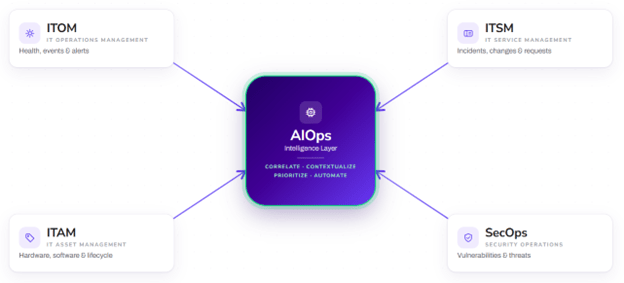
No one domain is complete on its own. AIOps becomes useful when it can reason across all four at once instead of one at a time.
From Siloed Insights to Operational Intelligence
In many organizations, these functions run as separate worlds, with separate tools, data, and teams.
Infrastructure sees alerts. The service desk sees incidents. Security sees exposure. Asset management sees inventory.
Each team has part of the picture, but not the whole view.
During an incident, valuable time is often spent connecting information across systems. The alert, related vulnerability, and recent change may all exist, but in different places.
AIOps closes that gap when alerts, services, assets, changes, and vulnerabilities share a common operational model. Instead of piecing together disconnected signals, teams and AI can operate from the same view.
That shift, from siloed insights to operational intelligence is where AIOps delivers its greatest value.
A Real-World Scenario
A business-critical application starts to slow down. Response times climb, users notice, and the calls start.
In a typical environment, teams manually compare alerts, logs, and timestamps across tools to understand what is happening. Business impact remains unclear, and root cause takes time to confirm.
In a context-aware environment, those same signals tell a more complete story.
Related alerts are corelated into a single incident. Service dependency data identifies the likely source of the issue rather than its downstream symptoms. Because the service is mapped to the business, teams immediately understand who is affected and what is at risk.
Associated assets, owners, recent changes, and known vulnerabilities are surfaced automatically. Recommended actions are informed by how similar incidents were resolved in the past.
The algorithms may be the same. The difference is the operational context behind them.
Why Foundational Capabilities Matter
This is why the foundational work matters more in the AI era.
Discovery and Service Mapping provide the relationships that make correlation meaningful. CMDB creates a shared operational model. ITAM adds ownership, lifecycle, and risk context. Operational workflows turn insight into action.
In a ServiceNow environment, this is why capabilities such as
Discovery, Service Mapping, Event Management, CMDB, ITSM workflows, ITAM, and SecOps become more valuable when they are connected.
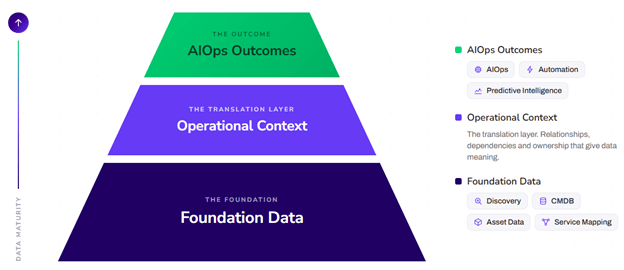
While these capabilities are often viewed as supporting infrastructure, they are what make AI effective.
AI amplifies whatever data and context it is given. Strong operational data produces recommendations teams can trust. Weak data produces recommendations that may sound confident but are built on flawed assumptions.
Organizations seeing the greatest value from AIOps are often the ones that invested in CMDB accuracy, tuned Discovery, maintained Service Maps, and connected operational workflows long before AI entered the conversation.
Federal and Enterprise Impact
For federal agencies and large enterprises, this goes beyond efficiency. Understanding the real business impact of an event helps teams focus on what matters most and strengthens mission assurance and service reliability.
Connecting operational and security context improves cybersecurity by framing exposure in terms of affected services, not just isolated scan results. It also supports accountability requirements under frameworks like FISMA and CMMC, which depend on accurate visibility into assets, configurations, risk, control ownership, and remediation activity.
The same operational context that makes AIOps work, including accurate CMDB data, complete asset records, mapped services, and operational history, can also support the evidence base auditors and security stakeholders expect. Organizations are not choosing between better operations and stronger governance. Done correctly, they are building the same foundation.
Conclusion
Artificial intelligence gives AIOps its speed, scale, and pattern recognition. Operational context gives it meaning.
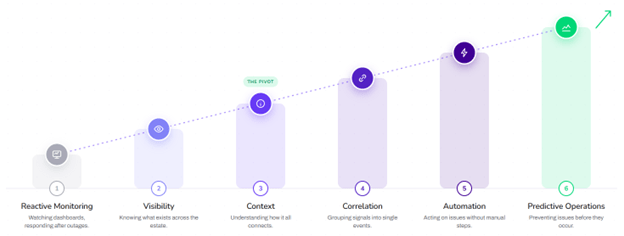
The strongest outcomes come from organizations that connect ITSM, ITOM, ITAM, and SecOps into a coherent foundation, so the AI can reason over accurate data and produce trustworthy results.
Used in isolation, AI delivers incremental gains. Built on strong operational context, AIOps becomes a core part of how the organization runs. Technology will continue to become easier to adopt, but context is what each organization must still build for itself.
Read the next blog: Why Waiting for Perfect Data Delays Better IT Operations
Let’s discuss your AIOps strategy today.